
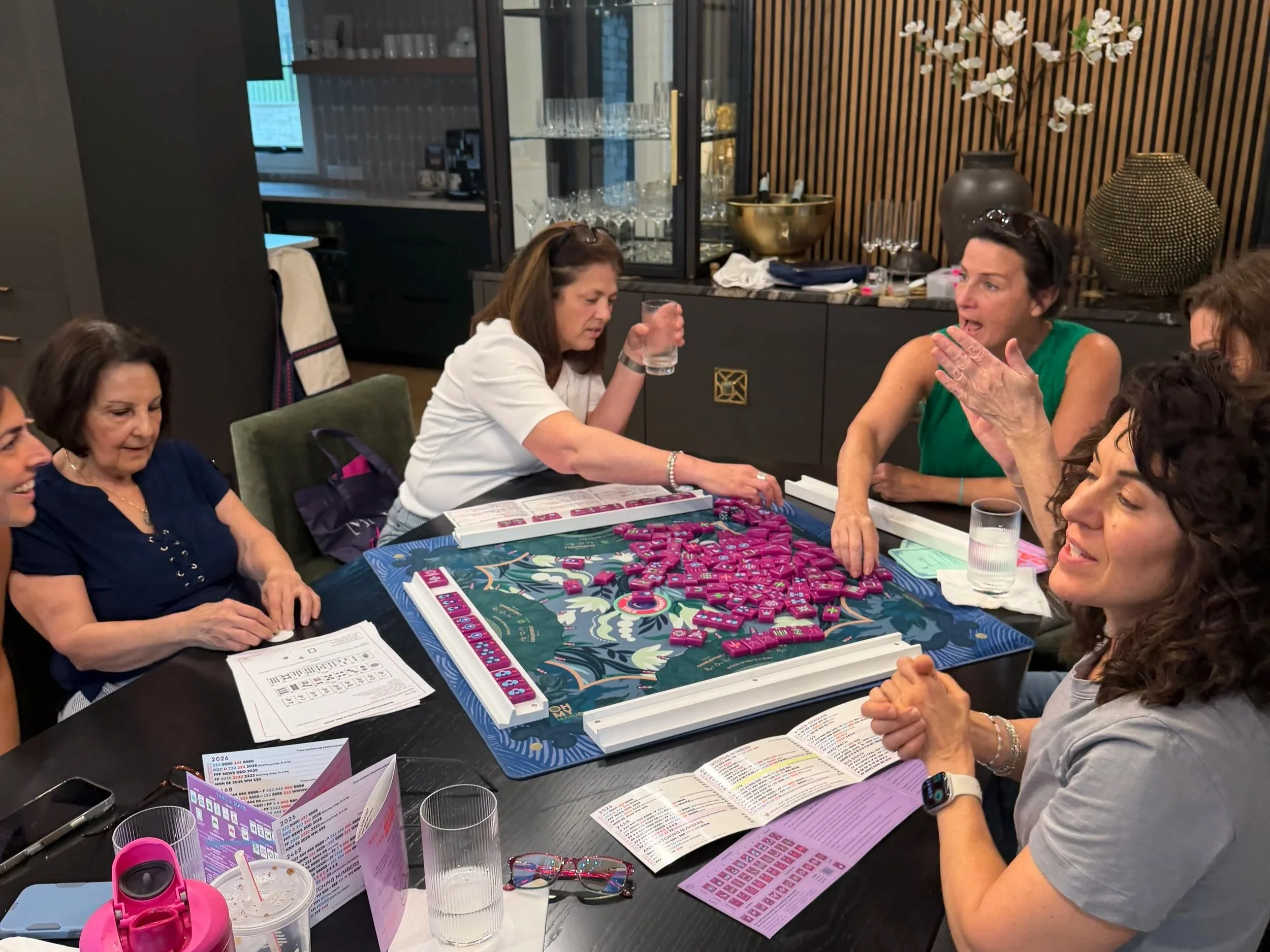
You did it! You took the class. You learned how to Charleston and you know that a Flower doesn’t have a suit, a Soap can be a dragon or a zero, and you can never ever use a joker in a pair.
You officially know how to play American mahjong... sort of.
There is a very specific moment that happens to almost every new mahjong player. You finish your beginner class feeling excited and then you look down at your card and think “Okay, but how am I ever going to do this without someone sitting next to me?”
Here’s the cold, hard truth about being a new mahjong player: you’re not supposed to be good at this yet.
Learning the rules of mahjong and becoming comfortable playing mahjong are two different things. Even a great teacher with a tried-and-true method (ahem!) can’t turn you into a confident mahjong player in one day. A beginner class can teach you how the game works. You can learn the Charleston, how to read the card, how Jokers work, what you can call, what you can’t call, and what actually constitutes mahjong. But there is no three-hour class that can give you the one thing you need next: PRACTICE.
You need to read the card again and again. You need to pass the wrong tiles. You need to choose a hand and realize after your first exposure that it was concealed. You need to discard something and immediately wish you could snatch it back off the table.
You need to PLAY mahjong.
No, you do not need to memorize the card.
Please don't try. Seriously. The card is a tool, not a test. And no, I don’t know it by heart.
Experienced players are looking at their cards, too. Over time, you'll naturally start recognizing patterns and remembering certain hands, but memorization isn't the goal.
What will happen with repetition is that the card will stop looking like a wall of numbers and letters. You'll start recognizing the neighborhoods. Then you'll start recognizing patterns. Eventually you'll look at your tiles and think, “Oh, this looks like Consecutive Run.”
That's progress, and it happens because you've seen those patterns over and over, not because you can recite every hand in your sleep.
Play slowly.
One of the biggest mistakes I see new players make is thinking they need to keep up with experienced players immediately. You don't. Speed comes later, and there are no timers in mahjong. Right now, your job is to learn to make decisions.
Look at your tiles. Look at your card. Think about what you're building. Pay attention to what's being discarded. Ask yourself whether you still have a realistic path to the hand you've chosen. I'd much rather see a newer player take a few extra seconds and make a thoughtful decision than frantically throw a tile because she feels like everyone is waiting for her.
Not everyone is patient with beginners, but don’t let that scare you. You are learning. Take the beat.
But you do need to play with people.
Online mahjong can be a fantastic tool. It's convenient, you can play a lot of games quickly, and it gives you the repetition you need to become more familiar with the card. But don't let online play become the only place you're willing to play.
There are parts of mahjong you only really learn around a table, like how to build walls, how to deal, and the correct passing order. You learn to follow the rhythm of the game. You hear other players call tiles and start noticing what people expose. You learn the unwritten rules of mahjong and proper table etiquette. You learn how different people approach the same game.
And most importantly, you become a mahjong player instead of someone who recently took a mahjong class.
Find a place where it's okay to be a beginner.
This one really matters. Your first few games after a beginner class probably shouldn't be at a table where you feel terrified to ask a question or scared of making a mistake. Look for guided play, beginner-friendly open play, or a patient group of friends (maybe from your class!) who know you're still learning.
There is a difference between helping a new player gain confidence and making her feel like she needs to apologize for taking a spot at their table. Find a game where your first win will be celebrated!
Don't wait until you feel “ready.”
This may be the biggest trap of all. New players sometimes join a game or a league and want to drop out because they don’t feel confident with the rules or think they’re not fast enough.
But how are you going to practice if you don't go play?
You don't become confident and then start playing. You start playing, and that's how you become confident.
Your first few games will feel clunky and awkward. That's okay. Then one day, you'll realize you didn't need help during the Charleston. A few games later, you'll recognize your hand faster. Then you'll make a defensive discard intentionally instead of accidentally. And eventually, you’ll be the one answering the questions for the beginner at your table.
Find your mahjong people.
This might be the part nobody tells you when you sign up for your first class. Learning mahjong isn't really the end goal, having people to play mahjong with is.
Maybe that's your three other friends you took a lesson with. Maybe it's a regular weekly table, open play, or a league. Maybe now you keep a mahjong set in your car because you never know when someone will want to play a quick game.
Whatever it looks like, find opportunities to sit down at a table with other people. The fastest way to get better at mahjong really is to play more mahjong, even if it feels uncomfortable at first.
The reason so many of us keep playing has very little to do with winning. We play for the friendships that started because four people took the time to learn the game.
You learned how to play mahjong. Now comes the fun part.
